

Local search engine optimization (SEO) requires a lot of diligence if you want to rank above competitors and attract high-quality leads. As you plan, local SEO should be a top priority to bring more attention to your local business and other online and offline marketing strategies.
A continuación se ofrece una guía completa para desarrollar una estrategia de SEO local y sacar el máximo partido a este lucrativo canal.
What Exactly Is local seo?
SEO local entails optimizing your business’s online presence to make sure people find you on busque en engines, specifically for local seo arches. For instance, you might own a local print shop and find that many other locations offer printing services in your city. Some competitors might appear in a box that contains top listings, while organic search results below list other businesses. To get the most traction, it’s ideal to go for those top listings in qué is known as the “Snack Pack.” At the same time, you should target organic results.
Through a good local seo estrategia, you can make sure your negocio ranks high when people look for the services or products you offer in their city. However, there are some steps you will need to take to get the best possible rankings in your area.
Aumente su presencia en línea con Lukasz Zelezny, un consultor SEO con más de 20 años de experiencia - programe una reunión ahora.


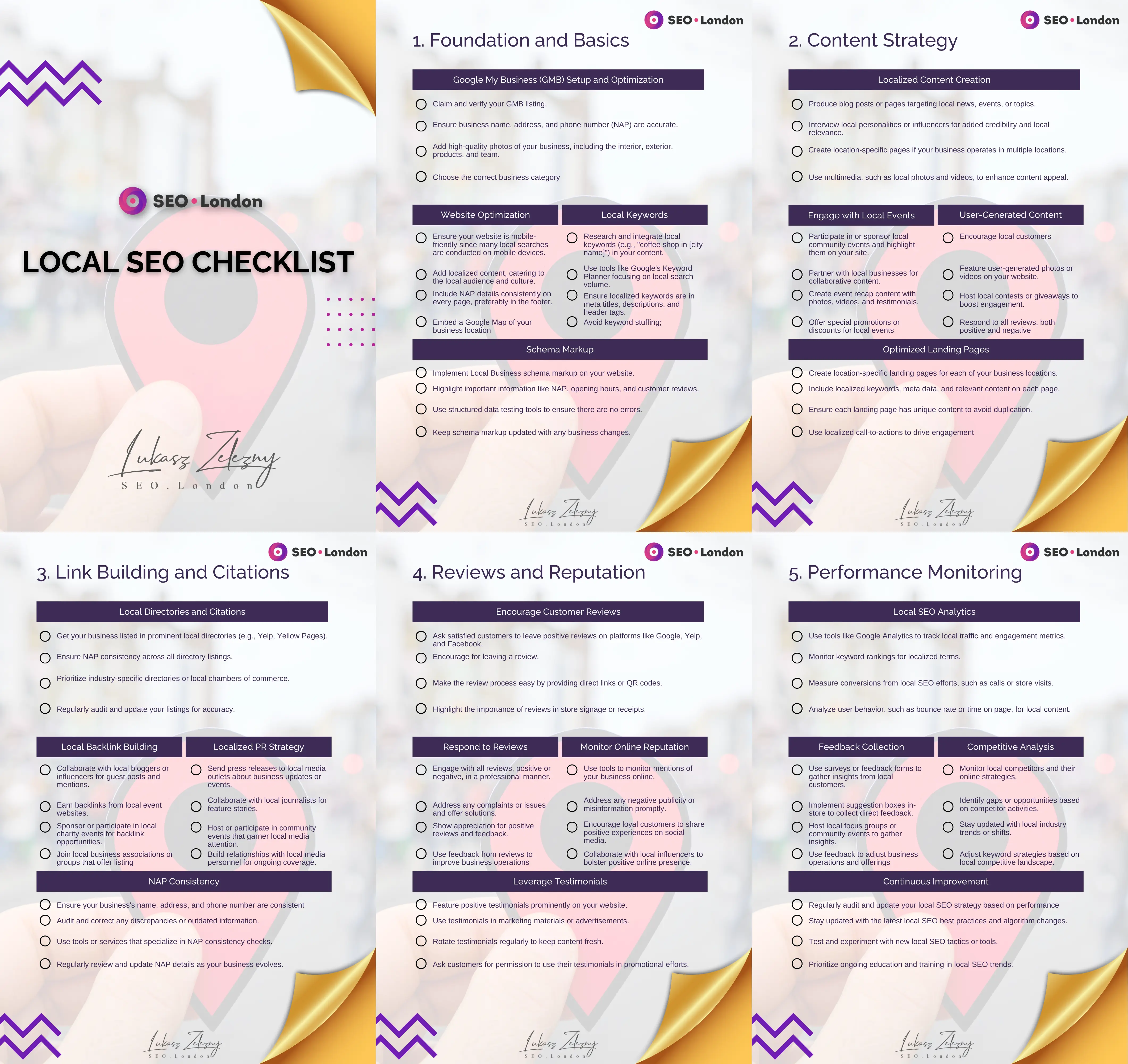
Descargar la lista de comprobación de SEO local
Make Sure Your Website Is Optimized for Mobile
The very first step you’ll need to take when implementing local seo is to determine if your website is optimized for mobile users. Using Google’s Mobile-Friendly Test tool, you can find out if your website is mobile responsive.
If your website makes it easy for mobile users to navigate, you’ll be able to attract many prospects looking for local businesses on their smartphones or tablets. Without a mobile-ready website, you’ll find that your website suffers tremendously when people are looking for you on the go, que could include both residents and people visiting your city.
Get a Google My Business Listing
Once you’ve figured out if your website is mobile-optimized, you should take the time to obtain a Google My Business listing. You can do all of the SEO you want with palabra clave investigación y en la página optimization that it’s possible to do, but it won’t be worth the effort without an official listing on Google.

Provide Your Business Name
Thankfully, Google makes it easy to get a Google My Business listing. To begin, simply visit Google.com/business. Sign in to your account or create one if needed. From there, you can enter your name, address, and phone number (NAP). In some cases, you may see your business name pop up in the drop-down list when typing it if you have a business that Google already recognizes.
Enter the Address
Once you’ve entered your business name, you can provide your new address. Your address could include an official location or you can use your home address if you work from home. Keep in mind that you don’t have to make your home address public–simply select “I deliver goods and services to my customers” if you want to keep your address private. Instead of a specific address, people will see the general location and service area when looking for your business.
Pin the Marker
After entering general business information, you can place the marker on the map to indicate precisely where your business is located. If your address isn’t specified, you can ignore this step. However, in addition to placing the marker, you will also need to categorize your business based on your services or products. According to Google, it’s often best to select a single category instead of multiple service categories.
List the Website and Phone Number
After pinning the marker, you can enter both your phone number and website. While you don’t need to provide Google with these details, it’s often best to list both if you want to make it easier for prospects to contact your business and get more information.
Qué preguntar a un consultor SEO
Verify Your Business
Once you’ve given Google all of the information it needs to generate a listing, you will need to verify the listing by phone or mail. Verification will entail following the instructions that Google provides. After verifying your business, you can provide any additional details you wish to add, including hours of operation, fotos of your business, logos, service page URLs, and in-depth business descriptions.
Investigación de palabras clave
With a Google My Business listing in place, you can now begin to optimize for local seo. The next step to take here will entail búsqueda de palabras clave based on the type of business you own and the location.
For example, some keywords for a local print shop might include ” print shops,” “print shop in , ,” or “printing services in “. You can then include these terms in your webpages, title tags, and meta descriptions to rango for them when people perform Google searches. It’s important to maximize keyword coverage without stuffing your contenido with unnatural uses of the keywords. Try to use them more naturally in your content and write for customers, not search engines.
When researching various keywords, you can look for examples in your industry using Google autocomplete when searching for local businesses, or you can use tools like the Google Keyword Planner. A good tool will show you metrics around each keyword, such as monthly search volume and ranking difficulty.
Using the keywords you found, you can optimize your homepage along with other pages with naturally incorporated keywords. Include keywords in headers and content. It’s also important to include them in title tags and meta descriptions, which people will see in Google search results.
Get Local Citations
After optimizing your website for clasificaciones orgánicas, build citations, which are a kind of online mencionar of your business. Both structured and unstructured citations are available. While structured citations include NAP details in a visual format, unstructured citations neglect this estructura for the purpose of including them in blog posts or other pages.
Citations are vital if you want to rank on Google’s “Snack Pack” and organic results. The main reason citations are crucial for ranking is the repeated appearance of a consistent NAP across multiple websites, which confirms the Google My Business listing information.
The importance of citations also makes it necessary to ensure that information is consistent across all citations. Make sure the business name, address, and phone number are the same and update them if there are any changes. Using certain citation tools, you can easily find and fix listings across multiple sites. For example, you can use Moz’s local seo arch tool to locate all listings for your business and see if any information requires fixes.
Practice Link Building
Construcción de enlaces will continue to be one of the most important factors in ranking on search engines. Next to citations, it’s also the second most important ranking factor for Google’s “Snack Pack.”
Link building entails many steps to build a network of high-quality links, but there are a couple of ways to begin the process for your local business.
Create Content That People Want to Share
To get started with link building, create content that’s highly shareable. If people really like your content and find it útil, they’re far more likely to link to it from another source. Helpful, informative blog posts and artículos are great for link building campaigns. You may rank for this content in search engines, or share on social media where people will spread it even farther.
Submit Guest Posts
Another way to utilize link building is to enviar guest posts to relevant industry blogs. Not only can you link to your website from a well-written guest post, but the publication’s audience may also begin to view you as an industry autoridad. Subsequently, guest posting can build both links and trust among prospects.
Taking all of these measures can help you build a winning local seo strategy and beyond. If you can take the time to desarrollar a strong foundation for your local business with local seo, you’ll be able to appeal to more prospects and remain competitive as SEO becomes more challenging.
Quizá también le interese leer:
- Guías de servicios locales de SEO
- Cómo atraer más llamadas a su negocio local
- Reseñas de SEO local
- Estrategia de SEO local
- Qué es el SEO local
- Cómo mejorar el SEO local
- Cómo optimizar el contenido de su blog para el SEO local
- Cómo encontrar clientes de SEO local sin hacer llamadas en frío
- SEO local sin dirección física
- Consejos para las citas locales de SEO
This post was last modified on %s = diferencia horaria legible por el ser humano
Entradas recientes
¿Qué importancia tiene la velocidad de la página para el SEO?
Cuando se trata de SEO, ¿qué importancia tiene la velocidad de la página para el SEO? En pocas palabras, la...
Cómo escribir un libro electrónico con IA
¿Quieres saber cómo escribir un ebook con IA de forma eficiente? Esta guía simplifica el...
Inteligencia artificial y redacción en SEO
¿Te preguntas cómo la IA puede mejorar tus habilidades de redacción SEO? Este artículo explora cómo las herramientas de IA...
El mejor comprobador de la clasificación de Google My Business
¿Necesita realizar un seguimiento de su clasificación en Google My Business? Un comprobador de clasificaciones de Google My Business ayuda...
Los 10 mejores tipos de redacción de contenidos en SEO para lograr el máximo impacto
Para mejorar su posicionamiento en los motores de búsqueda, debe conocer los distintos tipos de contenido...
10 mejores alternativas a Jasper AI (opciones gratuitas y de pago)
¿Está buscando alternativas a Jasper AI? Puede que esté buscando herramientas que ofrezcan una mejor relación calidad-precio,...